The balance of thinking and executing
Consulting trained me to think without following through. Startups trained me to do without thinking enough. Here's where I think the balance sits.
Four years into consulting, a hospital director looked at my slide deck and said, “This is very thorough. What do you actually think we should do?”
Two weeks, hundreds of conversations on the ground and a lot of data later, I had an answer. A restructure.
Clinical decisions and operational decisions were being made by two different people who barely spoke to each other, and every delay in that hospital traced back to that gap. I was confident in it. The director agreed with it. Execution sat with the Director of Operations, and I moved on to the next engagement.
Three months later I messaged the director, who by then had become a friend, just to catch up. The restructure never happened.
That’s the part of consulting nobody warns you about. The job does teach you to make decisions. You diagnose a system, weigh the options, commit to a recommendation and defend it in the room. What it didn’t teach me was what happens after you leave the room.
Execution was never my job. It belonged to whoever inherited the recommendation, and my entire outcome depended on whether they did it, and did it well. It was a quiet realisation that the best-reasoned plan in the world can die because the person running it never got round to it, didn’t have the authority to push it through, or had six other fires that mattered more that week.
Even so, I left consulting still believing that thinking hard was the job and the doing would sort itself out. My first big project at a startup luckily cured me of that.
I was building the sales campaign for a preorder launch: an email sequence to convert the 10K+ people who’d signed up to hear when preorders went live. I’d assumed they were warm. I spent a few weeks on the plan and another week building the emails. (Yes, I was also learning the email platforms at the same time, but that’s beside the point.) I was so proud of the plan.
But it fell apart on the very first send. Open rates were meh (less than 10%). Conversions were basically nothing.
Meanwhile our head of marketing, who had none of my consulting background, ran five ad tests on Meta in parallel. The creatives took a day to build. Simple still images, no decks, no sign-offs. Five variations live at once and a willingness to watch what happened. One of the still images with a testimonial worked, and it drove over 50 sales that day, our best day to date.
I was annoyed about that for longer than I’d like to admit. The email list was probably ice cold. But I could have saved three weeks and found out in one day.
But the bigger change was how I planned.
I started shipping smaller, faster, live tests instead of single well-reasoned plans, because being wrong fast beats being thorough once and finding out weeks later. I was beating the consulting mindset out of my brain.
If anything, I’ve swung too far the other way. Ten years into startups, I’ve spent most of that time in pure execution mode: run the test, ship the thing, move to the next one, without enough time thinking about what’s worth executing and how. Consulting overtrained me on analysis with no follow-through. Startups have overtrained me on follow-through with not enough analysis.
Here’s where I’ve landed.
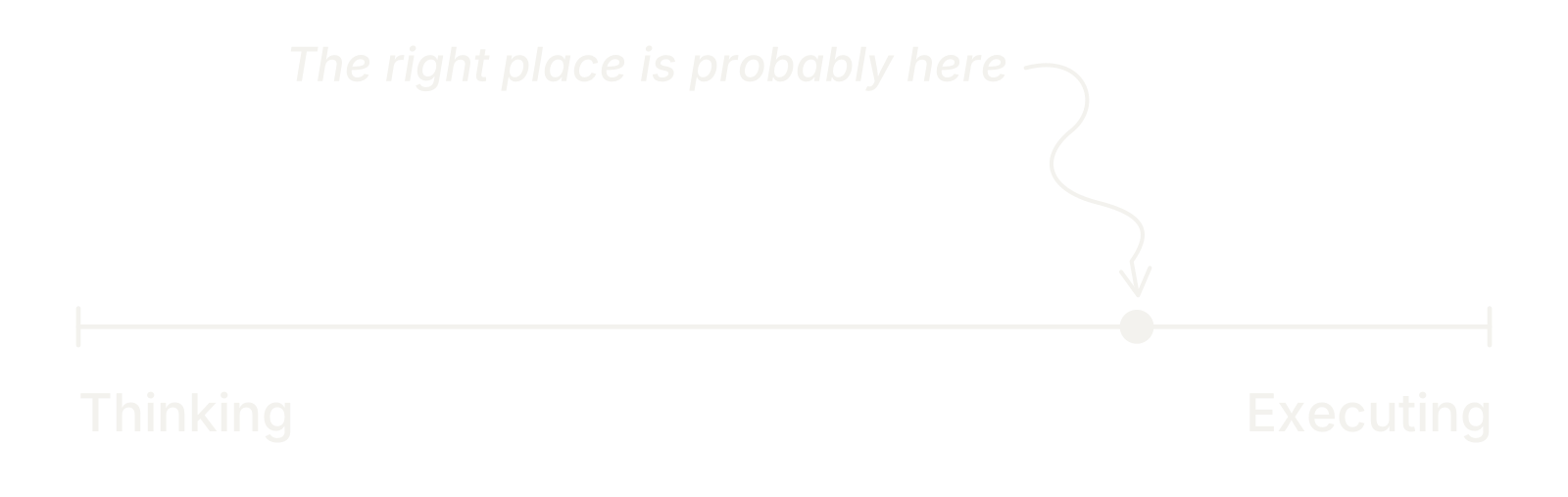
The answer isn’t halfway. It’s leaning hard towards doing, about three quarters of the way, because a live test will tell you more than any deck. But keep the last quarter for thinking, and spend it on the one question execution can’t answer for you: which tests are worth running at all. Even those five Meta ads weren’t random. Someone decided those five were the ones worth making. That’s the part in the middle, and it’s what I’m relearning now, on purpose.
That hospital restructure still nags at me, honestly. Not because I was wrong. Because I never found out if I was right.